
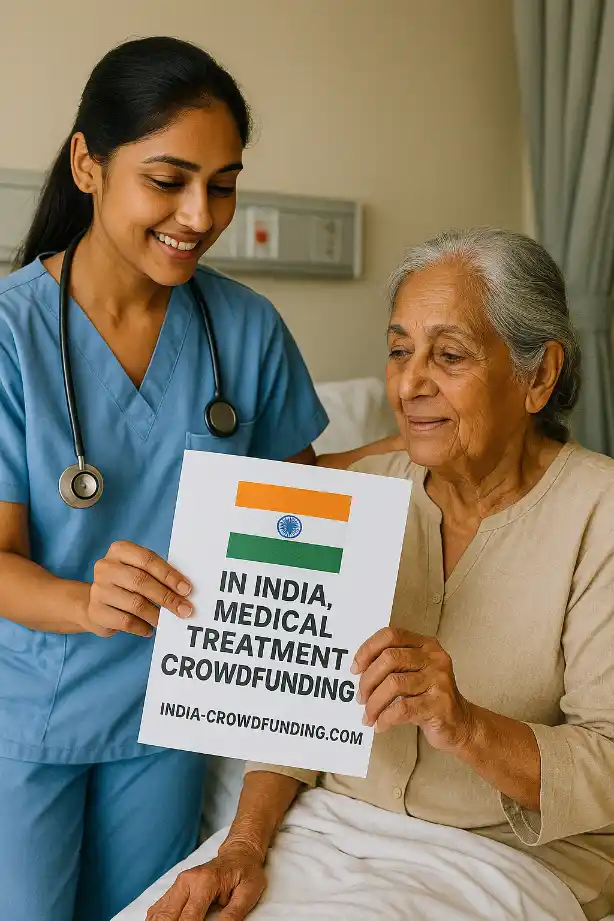
Why families turn to medical fundraising
Medical crowdfunding in India means asking friends, relatives and strangers online to contribute towards a patient’s treatment, usually through a platform that holds a campaign page and passes the money on to a hospital or a bank account. It is a donation model: supporters get nothing back, and the funds are neither a loan nor an investment. The person starting the campaign is usually a relative of the patient, and the page typically carries a diagnosis, a cost estimate and hospital paperwork.
The practice grows out of a gap between treatment costs and what a household can raise quickly. Insurance may not cover an advanced therapy, a transplant may need payment before surgery, and savings may already be spent on earlier admissions. A campaign does not replace insurance or government support. It sits beside them, and it works best when the family already knows the total amount needed and who will receive the money.
No campaign is certain to reach its target. Success depends on the story, the network of the person sharing it and the timing, and no platform can promise an outcome. The sections below cover what the main platforms charge, what proof they ask for, the public rare-disease portal, the legal oversight so far and the way fraudulent appeals are spotted.
How patient campaigns run on the main platforms
Ketto describes itself as a crowdfunding website in India where medical causes sit beside education, memorial, sports and NGO campaigns. Milaap names medical emergencies among its uses, offers phone help and an app, and says a fundraiser can be set up in under ten minutes. Donatekart lists medical campaigns under categories called Medical Emergencies and Save a Life and advertises round-the-clock assistance. Give.do, which does not use the word crowdfunding, hosts fundraisers by verified NGOs and lists health as one cause category.
ImpactGuru sets out four stages: start the fundraiser, which it says takes around five minutes; verify it by uploading documents, which for a medical case means hospital bills; share the page; and withdraw funds at any point during the campaign. It states that the money is not repaid and earns no interest. The site reports more than 50,000 patients funded, over 50 lakh donors and over 3.2 lakh fundraisers created, which are ImpactGuru’s own figures, so ask for evidence before relying on them.
Milaap’s withdrawal flow asks the fundraiser to request a transfer, confirm an SMS one-time password, pick a bank account, enter a full or partial amount, upload expense documents for each withdrawal and post an update. A family should ask each platform’s support staff directly how the hospital behind a bill is checked, and what is confirmed with the hospital and what is taken on trust.
What medical crowdfunding in India costs
Ketto’s published tiers are Bronze, which is free, Silver at 5 per cent and Gold at 7 per cent, applied to the amount actually collected. A 3 per cent payment gateway fee applies, and 18 per cent GST is added to both the success fee and the gateway fee. Ketto may change pricing at any time, and its terms say payouts are net of fees, gateway charges and taxes.
ImpactGuru lists Self-Driven with no platform fee, Assisted at 3 per cent, Elevate at 5 per cent and Co-pilot at 8 per cent, with a gateway charge of about 3 per cent on UPI, debit and credit cards, and a one-time administration and due-diligence fee of INR 3,000 plus GST. Its advertised 0 per cent fee carries an asterisk, and the plan table is where the conditions appear.
Milaap states a 0 per cent fee on donations and no upfront or fixed charges, funded by optional donor tips, though gateway charges and taxes can still reduce the amount that reaches the patient. Donatekart advertises 0 per cent for both platform and gateway fees, and a family should ask Donatekart to confirm its totals raised. A family comparing these should calculate what a hypothetical collection would net on each plan, with gateway charge and tax included, before choosing.
Documents and checks before a withdrawal
Expect to prove two things: who you are and that the treatment is real. For identity, Ketto’s terms ask for a mobile OTP plus one of PAN, Aadhaar or passport, and eligible campaigners need an Indian bank account. Milaap asks for government identity proof and bank details at withdrawal. Medical proof usually means hospital estimates, bills and a doctor’s letter, and ImpactGuru names hospital bills as the verification document.
Keep in mind that Ketto requires the PAN of a donor who gives cash above INR 24,999, and that campaigners must keep information accurate and give donors true progress reports. Funds on Ketto must be withdrawn or used within 45 days after the campaign ends. Planning the hospital payment schedule around these deadlines avoids money sitting idle or being returned.
Payment goes best to the hospital where that is possible, because it removes doubt about use. Where the family receives the money, the bills that follow should match the amounts withdrawn, and any surplus needs a stated plan agreed with donors.
The national rare-disease crowdfunding portal
The Union Health Ministry’s National Rare Diseases portal went online in the week before 17 August 2021. It lets donors give to a tertiary care centre or to a particular patient, and at launch the donations were not yet exempt under Section 80G. Within the first week, 30 patients had registered and 26,502 donations had been made.
The National Policy for Rare Diseases 2021 divides treatment funding into groups. One-time treatment support of up to INR 15 lakh comes through Rashtriya Arogya Nidhi, rising to INR 20 lakh for certain lysosomal storage and immune disorders for families below the poverty line or covered by PM-JAY. Lifelong non-intensive therapy is the states’ responsibility, and lifelong very expensive therapy is meant to draw on the crowdfunding portal.
A family of a child with a rare condition should therefore check eligibility under the policy before, or alongside, opening a private campaign, since public support and donations are not mutually exclusive under the policy.
Courts and oversight so far
Courts have started to examine the portal. In January 2022 the Kerala High Court, in Arif v. State of Kerala, asked the Centre and the State for affidavits on the national crowdfunding platform and on unused MLA funds for spinal muscular atrophy drugs. In a report dated 1 November 2025, the Delhi High Court, in Kiara Rawat v. Union of India, constituted a committee to oversee the rare-disease platform.
That Delhi committee is chaired by Dr Rajiv Bahl of ICMR and includes Dr V.K. Paul of NITI Aayog and joint secretaries from the corporate affairs and public enterprises ministries. It meets monthly, and its brief includes awareness and contributions from public sector companies and CSR budgets. The court noted about 3,981 registered patients. No dedicated law governs private medical fundraising platforms, so oversight of those platforms rests on their own terms, tax rules and general law.
Spotting and avoiding fraudulent appeals
Fake medical appeals do occur. In September 2026, police in Agra arrested a man for allegedly using forged records on a Shroff Eye Centre letterhead to run an appeal on the social platform X, with about INR 1.5 lakh reported raised. The case shows that a hospital name and letterhead alone prove little.
Before giving, ask whether the campaigner can be reached, whether the hospital confirms the patient and the estimate, whether payment goes to the hospital or to an account in the patient’s family name, and whether the page shows updates after earlier withdrawals. Be cautious about appeals that arrive only through forwarded messages with a personal UPI number. A donor who suspects an online financial fraud can use the national cyber crime helpline 1930.
For a campaigner, the reverse also holds. Publishing bills, naming the hospital, posting regular updates and returning or redirecting surplus money protect trust, and they matter more than the headline fee of any platform.
Tax, planning and what to do next
Donor tax treatment depends on the receiver. Platforms linking to charities with a valid 80G approval, such as Give.do and ImpactGuru’s linked benefit, may let donors claim a deduction, but gifts to an individual patient normally carry no such benefit. Under the Income-tax Act, gifts above INR 50,000 in aggregate in a year without consideration are taxable for individuals and HUFs, and the provision continues under the 2025 Act from 1 April 2026. A patient should ask a chartered accountant how crowdfunding receipts are treated in their own hands.
A sensible order is to confirm the total cost with the hospital in writing, check insurance and public schemes, choose a platform after working out net proceeds, collect documents, then publish and report regularly. If the target is not reached, ask the hospital whether staged payments are possible, and tell donors honestly what happened to the funds.