
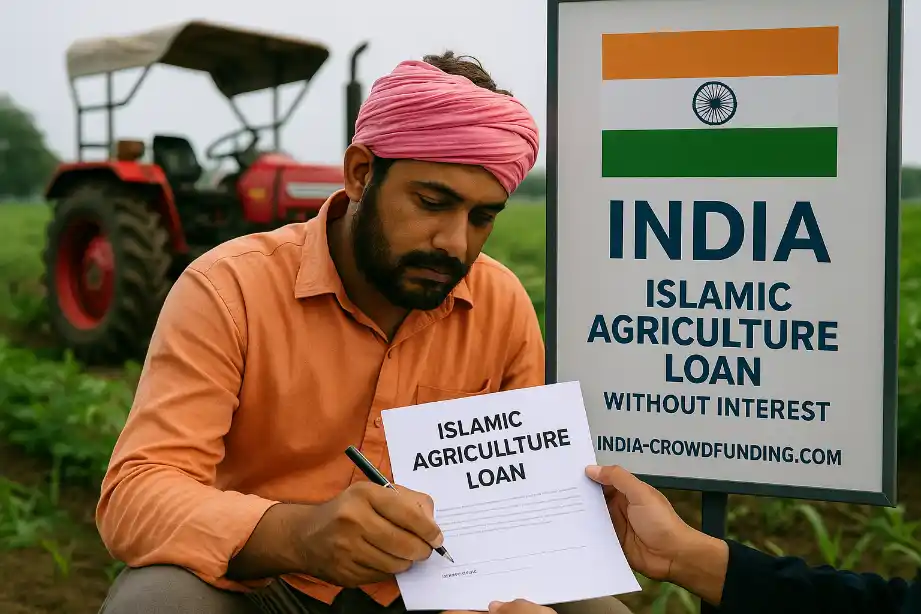
Farm loans without interest: where the idea stands
An Islamic agriculture loan in India would be farm financing in which the farmer pays no interest and the money is advanced through a contract such as salam, murabaha or a profit-sharing partnership. It is a concept more than a market: no licensed Islamic bank exists in the country, and no named provider of such farm credit should be assumed to exist.
That limit is worth stating before anything else. Pages that promise a halal crop loan or an interest-free tractor facility should be treated with caution until the lender, its legal form and its Sharia adviser are identified and checked independently.
The subject is still useful to understand. Agriculture is where classical Islamic finance developed some of its oldest contracts, and a farmer, a village committee or a scholar who knows them can judge what a real offer looks like, or build a small arrangement among trusted people.
Salam, the advance-purchase contract for crops
Salam is an advance payment for goods that will be delivered later. For agriculture it means a buyer pays the farmer today for a defined quantity and quality of produce, to be handed over at an agreed date. The farmer gets working capital without borrowing at interest, and the buyer takes the market risk between payment and delivery.
For the arrangement to be sound, the goods, the quantity, the quality and the delivery date must be clearly specified, and the price is paid in full at the start. A scholar normally checks that the crop is of a kind that can be described precisely and that the contract does not hide interest.
Who could be the buyer
In principle the buyer could be a trader, a processor, a co-operative or an investor. In practice, a farmer should not assume that any provider offers salam finance in India, and should regard it as a structure to discuss and not as a product to apply for.
Istisna, the manufacturing contract, and murabaha, a sale at disclosed cost plus a mark-up, are the other tools sometimes mentioned for buying equipment or inputs. Again, the same caution applies: they describe contracts, and a reader should ask any Indian farm lender in writing whether it actually uses them.
Interest-free lenders that are not farm lenders
Al-Khair Society in Bihar offers a demand loan that is for personal or household needs, not agriculture. The society operates in Bihar, Jharkhand, Uttar Pradesh and Delhi. A farmer who is a member could ask whether a household loan can bridge a hard month, but it should not be mistaken for crop finance.
IndiaZakat, run by the Association of Muslim Professionals, has a livelihood support category. It gives initial capital to start a small source of livelihood, mainly to rural people, but it offers no agriculture loan. Because this is zakat money, it is a grant for eligible people and not a repayable credit line.
Islamic Relief Worldwide lists a livelihoods project and a food project, and says its food work reached 5.4 million people in 13 countries. A reader in India should ask the organisation directly whether it works in India before treating it as a source of farm money.
LaunchGood hosts campaigns for relief, food and clean water, with 0 per cent platform fees, and offers no agriculture loan. Gifts raised there are donations, with nothing to repay.
Public schemes for crop credit that charge interest
Most Indian farmers who borrow do so through the Kisan Credit Card, a crop-credit instrument offered through banks. Eligible borrowers include owner-cultivators, tenant farmers, oral lessees, sharecroppers and self-help or joint liability groups. State Bank of India says the limit is set by crop pattern, acreage and the district scale of finance and carries interest, with government interest subvention on part of it.
State Bank of India also describes collateral and margin relief on smaller limits, so confirm the amounts with a branch before relying on them. Rates can change from year to year.
NABARD, the apex development bank for agriculture and rural credit, supports lending to farmers and rural enterprises through other institutions. Self-help groups under the national rural livelihoods mission are another route for women’s groups in villages.
These routes are interest-based. A farmer who decides not to use them for religious reasons should know what is being given up, such as the interest subvention, and should discuss it with a scholar and the household.
The Mudra scheme, by comparison, covers non-farm small and micro enterprises, so the field crop itself falls outside it. A farmer should ask the lender what counts as non-farm before assuming anything.
Informal and community arrangements, and the cautions
Where a farm family wants to stay interest-free, the realistic options are family loans, a trusted trader who pays in advance for crops under a salam-style agreement, or a profit-sharing partnership with a neighbour who supplies land or equipment. Each is a private arrangement with no regulator watching.
A Hyderabad summit in February 2026 promoted profit-sharing funding for small and medium enterprises, with musharakah and mudarabah named as models. It named no lender and no farm programme, so it shows interest in the idea and not an available source of farm credit.
- Write down the produce, quantity, quality, price and delivery date before any advance is paid
- Agree in writing who bears losses from drought, pests or flood
- Name two witnesses from the village and keep a signed copy
- Show the draft to a scholar before money moves
A written record protects both sides and also reduces the chance of a dispute turning bitter later.
Seasonal timing deserves a line in the agreement. Salam money is normally paid before sowing or during growth, so the delivery date should fall after the expected harvest, with a sensible allowance for delay. A date set too early forces the farmer to buy produce at market price to meet the promise, which can turn a helpful advance into a heavy burden. Agree in advance what happens if a crop fails for reasons outside anyone’s control, and let a scholar say whether the proposed remedy is acceptable.
Risks specific to an Islamic agriculture loan in India
Farming income depends on weather, prices and pests, which is why a fixed-repayment loan can become unmanageable after a poor season. A profit-sharing partnership spreads the loss between the parties, which is one reason Islamic scholars favour it, although it needs honest accounts and trust.
Advance-fee offers are a clear danger. Someone who asks for money to release an interest-free agricultural loan is not acting like a co-operative lender. In case of online fraud, the national cyber crime helpline is 1930; confirm the number on the official cyber crime portal before calling.
For regulated lenders, a Key Facts Statement has been mandatory for retail and small-business loans since 1 October 2024. Whether it covers a particular crop loan depends on the product, so ask the branch.
No approval and no yield can be promised. Plan around a bad season, not a good one.
Steps for a farmer who wants to stay away from interest
Begin with the household budget: what must be paid for seed, fertiliser, labour and irrigation, and when money comes in. A clear number tells you how much outside funding is needed and for how long.
Then make contact with the nearest interest-free society and ask plainly whether it lends for farm purposes. If it does not, note the answer and move on. Do not rely on a verbal assurance.
If you consider salam, find a scholar who understands crop contracts, and let that person review the buyer, the specification and the payment terms. If you consider a conventional scheme, ask the branch for the written terms and decide with advice from a scholar whether it is acceptable to you.
Keep expectations modest. At this stage, the real options are small community lenders, zakat-funded livelihood grants and interest-based public credit, and an Islamic farm loan from a licensed lender is not among them.