
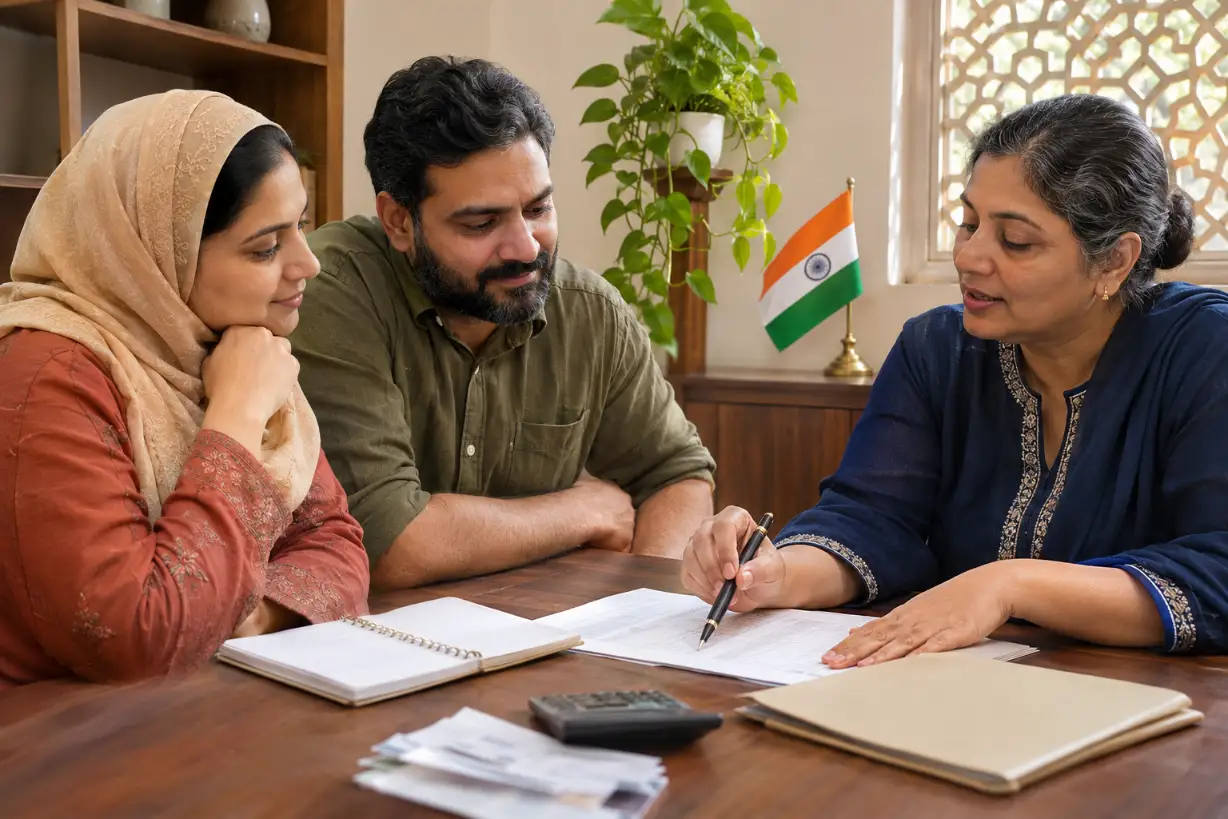
Steps in an application for interest-free finance
An Islamic finance application in India is the process of asking a society, co-operative or charity for interest-free money, and it follows the lender’s own form and the know-your-customer rules that apply to it. Because no licensed Islamic bank exists in the country, the applicant usually deals with a small credit society or a zakat-funded platform, not with a bank counter.
The sequence is similar everywhere. You identify a lender, confirm that it takes applications from your area, collect identity and address papers, fill a form, wait for verification and then sign a contract. What changes from one lender to the next is the list of documents and who checks them.
Nothing in the process guarantees an outcome. Approval depends on the lender’s funds, its rules and the information you give, and no one can promise acceptance or a date.
Identity and address papers most lenders request
Under the RBI’s 2025 KYC directions for commercial banks, an individual can prove identity and address with Aadhaar, which is generally not mandatory, or with an officially valid document such as a passport, a driving licence or a voter ID. A PAN or, for those without one, Form 60 is also required, and a Central KYC identifier can be quoted to avoid resubmitting the same papers.
These directions bind banks, not every society. An interest-free co-operative may ask for less or for different papers, so treat the bank rules as a guide to the usual set. The commonly asked documents are Aadhaar, PAN, proof of address, bank statements and photographs.
Which document counts as valid
The list of officially valid documents has changed over time. Older versions of the rules included a PAN card, while the 2025 explanatory note lists passport, driving licence, Aadhaar proof, voter ID, a job card signed by a state officer and a National Population Register letter. Ask the lender for its present list instead of assuming.
A small business owner applying as a sole proprietor should be ready to show two documents proving the business activity, such as a registration, a GST certificate or an income tax return, if the lender follows the bank standard.
Paperwork for a society loan form
Al-Khair Cooperative Credit Society asks for a demand loan application form, which carries a fee of Rs 20, together with identity proof, address proof, photographs, guarantors and security. The mention of guarantors and security shows that an interest-free loan is not necessarily an unsecured one.
Eisar Credit Souharda, which lists an interest-free gold loan, requires borrowers to hold society shares equal to at least 2.5 per cent of a secured loan or 5 per cent of an unsecured one. Plan for this cash on top of any fee, because it is paid into the society before the loan is released.
Janseva Cooperative Credit Society takes a different route for group loans: members save a small daily amount, and interest-free loans to a self-help group become available only after one year of savings. The sequence of savings first and credit later is common among such societies, so the applicant needs patience.
Ask every society for a checklist of documents on paper, and keep the copy you receive. It gives you something to hold the office to if the requirements change midway.
Zakat and charity platforms ask for different proof
IndiaZakat, the platform of the Association of Muslim Professionals, requires an identity proof, an income certificate and documents tied to the cause, such as fee receipts, medical reports or vendor bills. False information leads to rejection or blacklisting, which makes accuracy more important than speed.
Its cause approval process mentions a letter from the local masjid imam confirming zakat eligibility, called a Tasdeek Nama, and a cross-check of the beneficiary’s identity. Education support covers school or college fees only, not hostel, bus or food costs, and personal bank accounts are generally not allowed except for Nikah causes.
That process is written for those who approve causes. It is not a step-by-step manual for raising money yourself, so read the platform’s own policy before submitting an application. Zakat help is a grant for eligible people, so there is no repayment contract to sign.
Digital and video identification
Bank applications can be completed without visiting a branch in some cases. The RBI directions allow digital KYC and an optional video-based customer identification process, known as V-CIP, which uses face recognition and a live audio-visual interaction and is treated as equal to meeting in person. Business correspondents may help in an assisted version.
A borrower who opens a loan account through one-time-password e-KYC faces a limit: only term loans are allowed, capped at Rs 60,000 in total per year, and full due diligence is needed within one year. That ceiling is small, so a larger request needs the complete process.
Small societies often work face to face and on paper. If you apply online to any lender claiming to be interest-free, confirm its identity first, and never send identity scans to an unknown number or a chat contact.
Accessibility for applicants with special needs
The RBI directions say banks must not deny facilities to financially or socially disadvantaged people, including persons with disabilities, and that video identification must not exclude people with special needs. An applicant who cannot visit a branch or use a camera can ask the bank for an accessible alternative.
Co-operative societies and charities are not named in the same provision, so ask each of them directly. Request a home visit, a trusted representative or help with the form, and write down who agreed to what.
A family member or friend can accompany you, but you should still sign for yourself where possible, and the lender should explain the contract in a language you understand.
Preparing an Islamic finance application in India so checks go smoothly
Gather everything before you approach the lender. Names must match across documents, down to spelling and initials, because a mismatch between the identity proof and the bank statement is a common reason for delay. If a document carries an old address, bring a second proof that shows the current one.
Scan or photograph each paper clearly in good light, and keep the files in one folder on your phone with obvious names. Digital copies help when a lender offers an online route, and paper copies help at a counter. Never part with the only original of a document unless you receive a signed receipt for it.
Be exact about income. A platform that asks for an income certificate or a society that asks for guarantors is trying to understand whether you can repay or whether you qualify for help. Overstating income or hiding a debt can lead to rejection and, on at least one platform, to blacklisting. Honest figures protect you from that outcome.
Allow time. Verification takes time, and the lender may ask for further papers after the first submission. Treat an unexpected request as routine, and answer it promptly and in writing.
Before you sign: disclosure, re-checks and pitfalls
Regulated lenders must give a Key Facts Statement for retail and small-business loans, listing the all-inclusive cost and a repayment schedule. A society may not issue one, so ask for a written list of charges, the repayment dates and the penalty for a late instalment before signing.
KYC does not end at the first application. Banks must refresh customer details periodically, every two years for high-risk customers, every eight years for medium-risk and every ten years for low-risk ones. Keep your address and phone number current with whoever holds your account.
- Original and photocopies of identity and address papers
- PAN or Form 60, and your bank statements
- Passport photographs and, where asked, guarantor details
- Any society shares or fees payable in advance
- A written statement of charges and the contract text
Ask a qualified scholar to read the contract if you have doubts about compliance. The society’s own claim does not decide that question.