
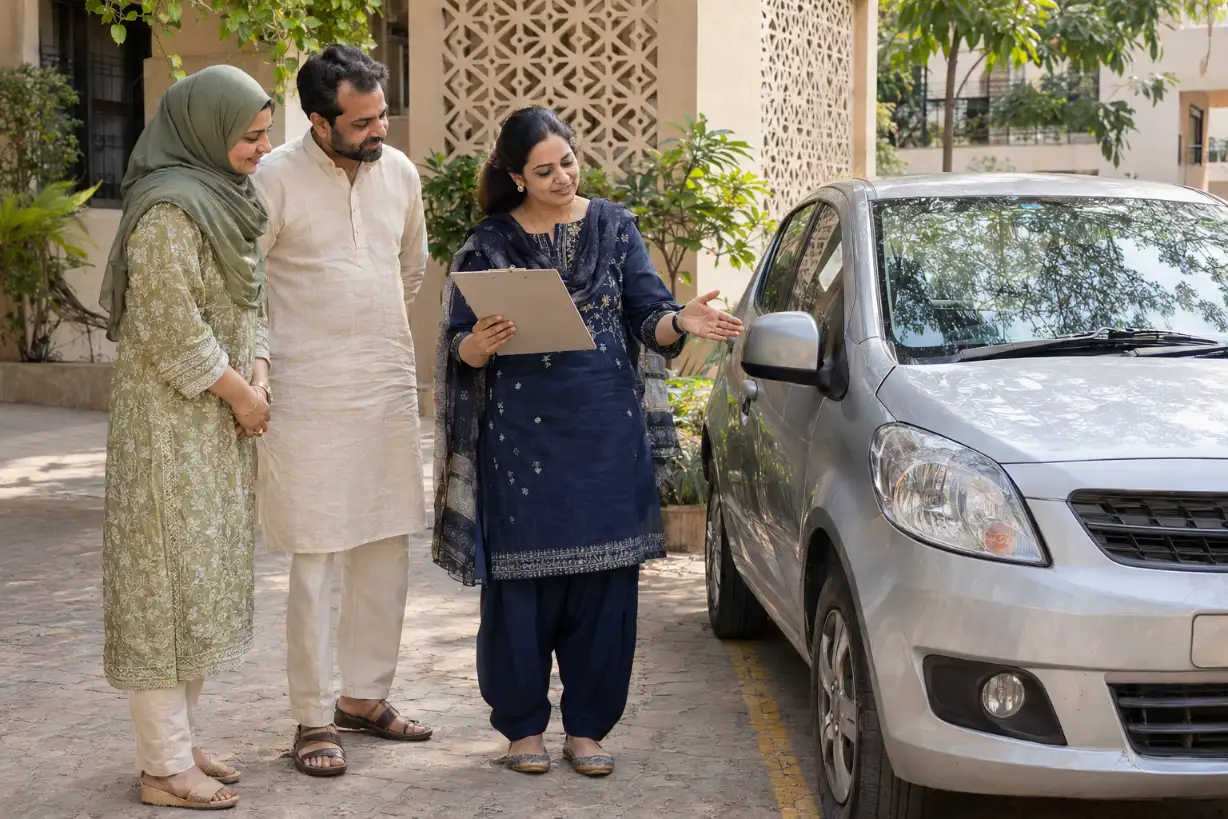
Takaful principles applied to a car
Car takaful in India would be a motor protection arrangement in which vehicle owners contribute to a shared fund that pays for specified losses to their cars, in place of buying a conventional insurance policy from a company that keeps the premium and carries the risk. No takaful operator is licensed by IRDAI in India, so the subject is best understood as a principle and a gap rather than a shelf product.
The international standard-setter for Islamic finance, the Islamic Financial Services Board, defines takaful in its glossary as a mutual guarantee in return for a commitment to donate an amount to a participants’ risk fund, so that members support each other against specified losses. The word that matters is donate. Each driver agrees to give a contribution, and that gift is what pays a fellow member’s claim.
The same glossary describes the tabarru’ commitment as the amount a participant commits to donate, used to help bear risks and to pay claims. The pool therefore works on gifts to the group, not on premiums paid to a company.
For a motorist, the practical difference is the answer to a simple question: whose money pays when a car is damaged? In a conventional policy it is the insurer’s. In takaful it is the pool’s, and the company running the pool is an operator, not the owner of the fund.
Why conventional motor cover raises Sharia questions
Islamic finance avoids interest, excessive uncertainty and gambling. Scholars who object to conventional insurance usually point at uncertainty and at the idea that a policyholder pays a premium and may receive nothing, while the insurer keeps what was paid. Takaful tries to answer this by turning the payment into a donation to a mutual pool whose surplus belongs to participants.
Whether a given arrangement is acceptable is for a qualified scholar or a Sharia adviser, and different scholars may give different answers. What can be said is that the structure aims to change who owns the money and who benefits from any surplus.
It is also worth separating the religious question from the legal one. A driver may feel comfortable with a mutual model and still need whatever cover Indian law requires for the vehicle. A driver must confirm those legal requirements with the vehicle registration authority and with the insurer.
How a motor takaful pool would normally work
In general terms, takaful is mutual protection in which participants contribute to a common pool to help members who suffer a loss, while an operator manages the pool for a fee, known as wakala, or for a share of profit. The glossary of Bank Negara Malaysia describes the pool as a common fund that pays benefits on pre-agreed events, and the wakalah contract as an agency in which an operator carries out a task for a principal.
Contributions and claims
A car owner would pay a contribution based on the vehicle and the cover chosen. A claim after an accident would be paid from the pool, not from the operator’s own capital, after the operator assesses it.
Fees and surplus
The operator would take a disclosed fee. If the pool collects more than it pays out, the surplus normally stays with participants, in some designs as a refund or a reduction in next year’s contribution. If claims exceed the pool, rules differ by model, and a buyer needs the operator to state what happens in writing.
These descriptions are generic. They are not an account of any product sold in India, so a driver should not expect any seller to match them exactly, and should ask for the real terms before agreeing to anything.
What motor cover usually has to answer
Whatever the structure, a car owner needs clear answers to the same practical questions. Does the cover protect against damage to the car itself, against harm done to other people or property, or both? Is theft included? Are natural calamities such as floods covered? What is the deductible a driver must bear on each claim?
The National Centre for Financial Education publishes a government-backed handbook on motor insurance, and the insurer’s own consumer guide will set out the cover, exclusions and claim steps for the policy you are offered. Read both before paying, and compare the insured value, the deductible and the exclusions line by line with any mutual offer you are shown, so that two products are judged on the same terms. Ask the insurer to state in writing how a claim for theft, flood damage or damage to another person’s vehicle would be handled, because those are the points on which motor disputes usually arise. Keep the reply with your policy papers.
The sensible approach is to read the actual policy wording of any product before paying. Look for the definition of an insured event, the list of exclusions, the claim notification period and the garages or surveyors the operator accepts. Where the wording is vague, ask for clarification by email so the reply exists in writing.
Availability of car takaful in India today
No takaful operator is licensed by the Insurance Regulatory and Development Authority of India (IRDAI). The same holds for home, health and family cover: no takaful version is licensed for sale in India.
Two earlier developments are worth knowing. In July 2005, the Life Insurance Corporation announced a joint venture called Indo-Saudi Insurance Company to introduce takaful, but the plan concerned Saudi Arabia and Saudi law, not Indian motorists. A separate pure mutual model for India, operating without risk transfer under public trust or society law and supported by an international mutual insurers’ body, aimed to reach half a million people over five years.
Neither item amounts to a motor product. So the plain answer for a driver in Delhi, Hyderabad or Kozhikode is that no licensed car takaful policy is available, and ordinary motor insurance from a registered insurer is the product that actually exists. A driver who hears otherwise should ask the seller for the name of the licensing authority and for the contract in writing before paying anything.
Practical choices for a driver who wants a mutual approach
A buyer who wants to avoid conventional insurance has few routes. One is to ask insurers whether any product is offered on a mutual or takaful basis and to request the contract and the Sharia approval in writing. Another is to consult a local scholar about whether a conventional policy, taken because the law or a lender demands it, is acceptable as a necessity.
A third route is community mutual help outside the insurance regime, but its legal footing differs by structure. A driver relying on informal pooling should remember that it gives no regulated claim right and no ombudsman route.
Whatever path is chosen, keep proof of the vehicle’s registration, driving licence, previous claims history and photographs of the car at the start of cover. These papers help in any claim process, whether the pool is mutual or commercial.
Warning signs when someone sells Islamic motor protection
Treat a seller with caution if they use the word takaful but cannot name a regulator, a legal entity or a Sharia adviser. Be careful if the price looks like an ordinary premium but the document calls it a gift with no terms attached, or if the seller promises that every claim will be paid.
- No written contract that explains how the pool is run and who gets any surplus.
- No named licensing authority or registered legal entity.
- Payment requested in cash or into a personal account.
- A guarantee that claims will never be refused.
- No Sharia approval that you can read.
If a scheme is suspected of taking money without authority, the Reserve Bank’s Sachet portal accepts complaints about unauthorised deposit schemes, and the Insurance Ombudsman route exists for disputes with registered insurers. Both are for different situations, so describe the problem accurately when you approach either.