
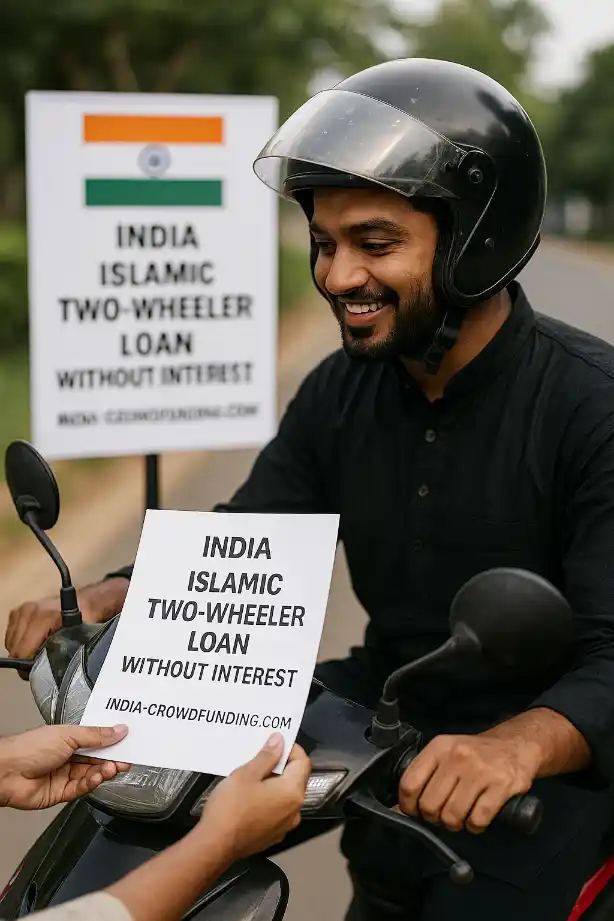
Financing a two-wheeler without interest
An Islamic two-wheeler loan in India would be a way of buying a motorcycle or scooter on instalments without paying interest, using a contract such as a mark-up sale or a gradual buy-out. The honest starting point is that no regulated lender sells such a product. Anyone who advertises such a product has to be asked for proof, in writing, before a single rupee moves.
For many families a two-wheeler is the main way to reach work, a market or a college. That is why the interest question becomes personal. A standard vehicle loan from a bank or a finance company charges interest, and a believer who avoids riba cannot treat that as a neutral detail. The choice then comes down to paying in full, saving first, borrowing from relatives without interest, or finding a structure that a scholar accepts.
The Islamic alternative to interest does not mean a cheaper vehicle. A seller or financier who wants a return still has to earn it through a real sale or a real share in ownership, and the price paid over time can be higher than a cash price. What changes is the nature of the obligation: a fixed sale price agreed at the start, instead of a charge that grows with time and balance.
No ruling on any particular contract is given here. Whether a specific motorcycle purchase plan is acceptable depends on the exact documents, and a qualified scholar or Sharia adviser is the right person to decide that.
Is an Islamic two-wheeler loan in India available today?
India has no licensed Islamic bank, and ordinary banks lend on interest under the Banking Regulation Act, 1949. The RBI put forward an Islamic window in conventional banks in February 2016, but the finance ministry did not accept it, and in a reply made public on 13 November 2017 the RBI said it would not pursue Islamic banking. That leaves no regulated route in which a bank sells you a halal motorcycle plan.
No lender is known to finance two-wheelers on Islamic terms. A reader looking for a sharia-compliant provider that finances two-wheelers, cars, homes or farm inputs should ask the cooperative or institution directly. The few small cooperatives and non-banking style entities that work on interest-free lines are not known to finance vehicles. For that reason, no provider is named here, and a reader should ask any society in their town, in writing, what it lends for.
The crowdfunding sites tell the same story. IndiaZakat lists categories such as education, healthcare, livelihood support, relief, orphan support, scholarship, women empowerment and Nikah. It shows no vehicle or loan content. Ketto and Milaap describe fundraisers for medical, education, personal and charitable needs, and neither offers loans. LaunchGood presents itself as a platform for Muslims with a stated 0% platform fee, yet it offers no motorbike or loan product for India.
How a murabaha purchase of a motorcycle would work
Murabaha is a sale at cost plus a disclosed mark-up, paid later or in instalments. The rule that matters most is that the financier must own the asset before selling it. In a motorcycle case, that means the financier buys the vehicle from the dealer first, holds the ownership risk for a moment, and only then sells it on to you for a price made of cost and a stated margin.
Three questions help test whether a plan is truly a sale. First, does the paperwork show the financier as the buyer from the dealer, or does the dealer simply release the vehicle to you while the financier sends money? Second, is the final price fixed in the contract with no clause that raises it because you pay late? Third, is the margin stated clearly as part of the sale and not described as a rate per year?
The late-payment point deserves care. Under the RBI conduct rules for lenders, a penalty for a missed instalment must be a penal charge disclosed upfront, not additional interest, and it cannot be capitalised. Whether a given late-payment clause is acceptable is again a matter for a scholar. A contract that quietly compounds a penalty is the opposite of what the structure is meant to do.
Registration and ownership
A vehicle has to be registered in someone’s name, and the registration papers show who legally owns it. If the plan is that you are the buyer from day one, find out how the financier protects its position, and whether any charge is noted on the papers. These practical details belong in the contract and should be read before signing, with a lawyer’s help if needed.
Gradual ownership through a partnership
Diminishing musharakah is the second structure that people mention for large purchases. The financier and the buyer jointly own the asset, the buyer pays a use charge for the financier’s share, and over time the buyer purchases that share in parts until nothing remains. Profit and loss in a partnership follow agreed ratios and capital, which is why scholars distinguish it from a loan.
For something as ordinary as a scooter, the machinery of joint ownership may be heavier than the amount justifies. A partnership needs a clear valuation, a payment schedule for buying out units of the share, and a rule about what happens if the vehicle is damaged or stolen. These are exactly the details where a poorly drafted contract hides interest in disguise. A single missing clause can turn a partnership into a loan with a different name.
If a dealer or agent uses the word partnership, ask who contributes the money, who bears the loss if the vehicle is written off, and whether the monthly payment changes with the vehicle’s value or stays fixed whatever happens. A real partner shares risk. A fixed monthly figure that never moves, and protects the financier from every possible loss, looks like a loan.
Interest-free societies and the scale of what they lend
Interest-free credit does exist in India in small forms. Al-Khair Cooperative Credit Society in Patna said in 2022 that it had lent over Rs 1,250 million to nearly 25,000 people, both Hindus and Muslims, over about twenty years. In Hyderabad, Sahulat said in 2021 that it lent Rs 5,000 to Rs 1 lakh to small traders, with 33 branches and more than 46,000 members. In Karnataka, Jamaat-linked Souharda societies work in nine towns, including Bhatkal, Udupi and Mangalore.
None of these societies is known to finance vehicles. Their loans are small and aimed at traders and small needs, repaid at the principal amount, which matches the idea of qard hasan, a benevolent loan with no profit for the lender. If you live near one of these societies, a visit is a reasonable step to ask what they lend for, what membership requires and how repayment is collected.
These bodies are registered under state cooperative law or as societies and trusts and are not RBI-licensed lenders. That affects your protection. A scheduled bank sits under the RBI Integrated Ombudsman Scheme, while a cooperative answers to the state Registrar of Cooperative Societies. Do not place savings with any such body without learning its legal form.
Why zakat and donation money is not vehicle finance
Some readers wonder whether zakat or crowdfunding could fund a motorbike. Zakat is obligatory alms of 2.5% on qualifying wealth held for a lunar year above the nisab threshold, and the Quran, in verse 9:60, names eight categories of recipients: the poor, the needy, zakat administrators, those whose hearts are to be reconciled, the freeing of captives, debtors, the cause of God and stranded travellers. Whether a vehicle purchase falls within a category is a question for a scholar, and the platforms do not present such a use.
The platforms themselves frame their work around specific needs. IndiaZakat, an initiative of the Association of Muslim Professionals in Mumbai, groups its causes under headings such as livelihood support and education. A person whose livelihood depends on a vehicle might ask a scholar whether livelihood support applies, and should ask the platform whether such a listing is possible. A donation campaign also gives no promise of success, and the amount raised can fall short.
Donation-based crowdfunding means no repayment and no return. That is different from a loan, and a campaign that promises to repay donors with extra money has changed its nature. Treat any such offer cautiously, and remember that the rules for peer-to-peer lending platforms bar them from promoting lending as an investment with assured returns.
Safe steps before signing any vehicle plan
Start by asking for the Key Facts Statement. It has been mandatory for retail and MSME loans from regulated lenders since 1 October 2024 and must show the all-inclusive cost, the interest type and the annual percentage rate along with a repayment schedule. A lender cannot add charges that are missing from it without your explicit consent. For a plan that claims to be interest-free, this document is a useful test, because any hidden charge becomes visible.
Under the Digital Lending Directions of 8 May 2025, disbursal must go to the borrower’s own bank account and repayment must go directly to the lender, with a cooling-off period of at least one day. A request to send money to a third party’s wallet or to an agent is a warning sign. The RBI also announced a public list of reported lending apps, and says that list is not an endorsement; an app absent from it deserves suspicion.
If you suspect online financial fraud, the National Cyber Crime Reporting Portal and the helpline 1930 are the places to report it. For complaints against banks and non-banking lenders, the RBI Integrated Ombudsman Scheme applies. Before any of that, though, a calm comparison helps: the total you will pay, the paperwork, who owns the vehicle at each stage, and what a scholar says about the contract. Waiting a few months to save can be a sounder path than signing a plan nobody can explain.