
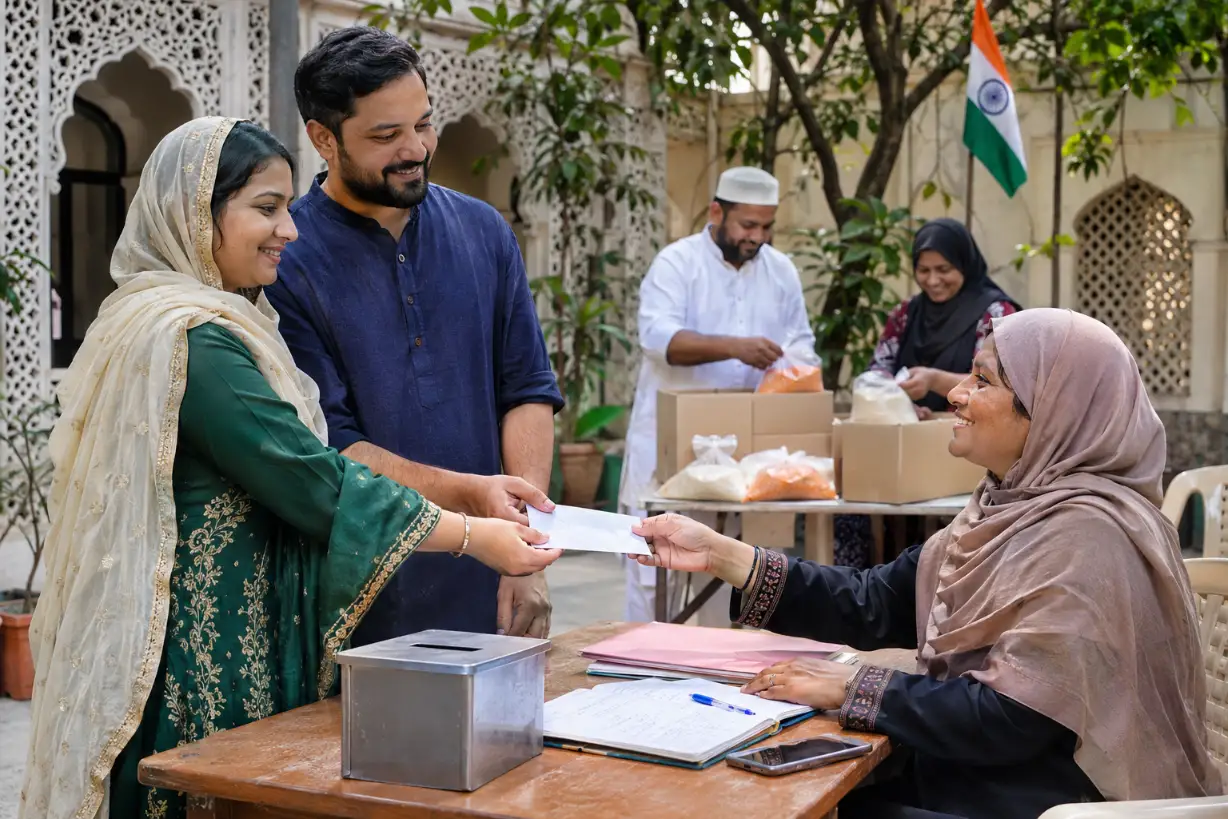
Voluntary giving as the basis of a donation campaign
Donation-based Islamic crowdfunding in India means collecting many small voluntary gifts online for a cause, with no repayment, no profit and no goods promised to the giver. The Islamic element is the intention and the purpose: the giver gives as sadaqah, which is voluntary charity, and the cause is something a scholar would regard as a good use of such money, such as schooling, food, medical help or relief after a disaster.
This is the simplest of the crowdfunding models used in the country. Reward campaigns give a perk back, lending campaigns expect repayment and equity campaigns offer a stake. A donation campaign asks for none of these in return. That simplicity is also its main risk, because a giver has nothing to rely on except trust in the person or organisation asking.
Sadaqah differs from zakat. Zakat is the obligatory alms of 2.5 per cent on qualifying wealth held for a lunar year above the nisab threshold, and its recipients fall into eight categories named in the Quran. Sadaqah has no fixed rate, no threshold and no limit on timing or recipient. Because of this freedom, sadaqah is the usual choice when a campaign helps a person or project that would not strictly qualify for zakat, such as a mosque repair, a library or a community kitchen.
Who gives and who asks
Givers range from a student sending a small amount by UPI to a family setting aside a monthly sum. Those asking include registered charities, local committees, neighbourhood groups and individuals with a personal need. The form of the asker matters later, when questions of tax receipts and accountability come up.
Platforms that gather sadaqah alongside other contributions
IndiaZakat.com describes itself as India’s first zakat-based crowdfunding platform. It is run as an initiative of the Association of Muslim Professionals, a body founded in 2007 that launched its own zakat fund in 2013, with the website itself launching in 2020. According to the platform, it pools zakat, sadaqah, fitrah and other charitable contributions for poor and underprivileged people.
The platform lists cause categories that show what donation campaigns commonly cover: education, healthcare, livelihood support, relief funds, orphan support, scholarships, women’s empowerment, poverty alleviation and help with marriage costs. These headings are a useful guide to the range of needs that sadaqah appeals address in practice.
The platform also says it charges no commission, follows Sharia and scholar guidance, is audited every year and holds 80G and 12A registrations, and that the Association’s local network verifies causes in more than 200 cities. These are the platform’s own statements. A giver who wants more than a promise can ask for the registration details and the latest audited accounts.
Beyond this one platform, the Zakat Foundation of India in New Delhi lists programmes in coaching, scholarships, tailoring institutes, orphanages, medical services, disaster relief, feeding and waqf. A giver should ask it in writing for its founding year, registration number and 80G approval before treating it as a tax-deductible recipient. The Human Welfare Foundation likewise lists health camps, awareness work and financial aid support; a giver should ask it whether it accepts zakat, whether it is registered and whether it holds 80G approval.
Donation-based Islamic crowdfunding in India: how gifts are paid and what they cost
Gifts reach an Indian campaign through net banking, UPI and cards. One platform’s published policy says that bank transfers carry no platform charge, while payments through the Razorpay gateway carry a charge of 1.5 to 2.5 per cent. The cost of a gateway is therefore a real part of the picture even where the platform itself takes no commission.
Other platforms handle fees differently. Milaap, which is used mainly for medical and personal appeals, lists a platform fee of zero on donations and relies on optional tips from donors, though gateway charges and taxes can still reduce the amount sent to the campaigner. A giver who wants the whole gift to arrive can check whether a bank transfer or a different route avoids these deductions.
For an organiser, the lesson is to state clearly how much of each gift arrives. If a gateway takes a share, the campaign page should say so, and the target should be set high enough to cover it. Givers are generally more comfortable with a plain account of costs than with a claim that nothing is ever deducted.
Refunds and unclaimed money
Donations are normally final. The policy quoted above allows a refund only in cases of fraud or where a cause is cancelled before any money has been paid out, with approved refunds returning in 12 to 15 working days. It adds that funds left unclaimed after 90 days go to similar causes in the next quarter. Because policies differ, a giver should read the refund terms of any platform before sending money.
Tax receipts and who may receive them
A donor in India gets an income-tax deduction only when the charity holds a valid 80G approval and, under the old tax regime, when the receipt shows the charity’s details. Without that approval a gift is a private act of generosity with no deduction. The platform mentioned above says it issues 80G receipts to donors who provide PAN or Aadhaar details, so those identifiers are needed for the paperwork.
The legal form of the receiving body matters. Charities in India are commonly set up as public charitable trusts, as societies under the Societies Registration Act, 1860, or as Section 8 companies under the Companies Act, 2013. A private person collecting for a neighbour’s treatment is none of these, and a gift to that person will not carry an 80G receipt.
The Income-tax Act 2025 applies from 1 April 2026 and carries section 80G forward as section 133. The 1961 Act still governs earlier years. A donor claiming a deduction should ask a tax adviser about the exact limits and conditions under the new section for the year in question.
A further caution concerns large personal gifts. Gifts without consideration above INR 50,000 in total in a financial year can be taxable in the hands of an individual receiver, which matters to a family that receives a large sum for itself through an appeal.
Gifts from abroad and the foreign contribution rules
Money sent from outside India is treated more strictly. The platform policy quoted earlier allows donations only from Indian nationals and non-resident Indians paying from Indian bank accounts, and does not accept foreign donations made with non-Indian cards or accounts. A relative in another country who wants to give may therefore need to use an Indian account of their own.
Behind this sits the Foreign Contribution (Regulation) Act, which the Ministry of Home Affairs administers. An organisation that wants to receive foreign contributions generally needs the registration the Act requires. The 2020 amendment cut the share of foreign contributions that may be spent on administration from 50 per cent to 20 per cent and required the receiving account to be held at a State Bank of India branch in New Delhi. New rules effective 22 June 2026 changed other parts of the regime, including the annual return.
Ask a legal adviser whether an individual’s gift from a foreign relative to a campaign for another individual falls under the Act. A campaign organiser who expects overseas support should obtain advice before announcing that foreign gifts are welcome.
The practical rule is to keep records. For every gift, the organiser should be able to show who gave, how much arrived, through which account, and what the money was used for.
Spotting a doubtful appeal before you give
Emotional appeals travel quickly on social media, and some are false. A documented case from September 2026 involved an arrest in Agra, where police said a man used forged medical records on a hospital letterhead to raise money in an online appeal, with about INR 1.5 lakh reported. The case shows that a convincing document is not proof.
A sensible giver looks for a registered organisation, a named contact who can be reached, a clear statement of what the money will do, and a record of reports from earlier appeals. Pressure to give at once, requests to pay into a personal account for a large institutional need and refusal to share any details are all reasons to pause.
Where an appeal claims to be zakat or sadaqah collected for the poor, the giver can also ask who verifies the recipients and who audits the accounts. Platforms that publish an annual audit and a verification process offer more to check than a bare message, though even these claims deserve a question or two.
Suspected online financial fraud can be reported on the national helpline 1930; confirm the number on the government’s cyber crime reporting site first. The Reserve Bank’s Sachet portal handles reports on unauthorised deposit schemes, which is a different problem from a false charity appeal.
Governance and the scholar’s role
A donation campaign is only as sound as the people holding the money. Good practice includes a separate bank account for campaign funds, two named people who approve payments, written receipts, and a short report to givers once the cause is complete. A report that lists amounts received, amounts spent and anything left over is more useful than a general thank-you.
Leftover money needs a plan stated in advance. If a family’s treatment costs less than expected, or a building project closes under budget, the appeal should say whether the surplus will go to a similar cause. The policy of one platform quoted above sends unclaimed funds to similar causes, which is the kind of rule that should be announced before the first gift.
On questions of religious compliance, no platform’s own claim settles the matter. Whether a given appeal qualifies as sadaqah or zakat, whether the recipient is eligible and whether the use of funds is acceptable are matters for a qualified scholar or Sharia adviser. India has no licensed Islamic bank to certify any of this, and the platforms’ statements about scholar approval are theirs to document.
Organisers and givers can both benefit from asking the scholar early. A short written opinion on the purpose of a campaign, kept with the accounts, answers many later doubts from givers, family members and the wider community.