
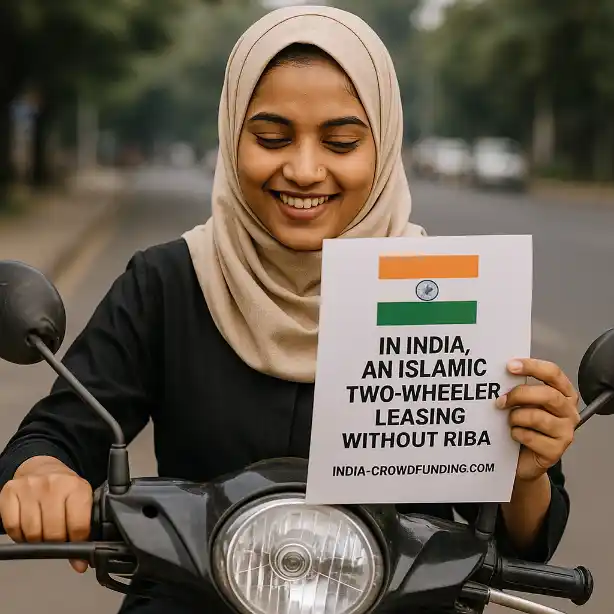
Two-wheeler leasing under Islamic principles: what the term covers
Islamic two-wheeler leasing in India refers to renting a motorcycle or scooter from a financier who owns it, for an agreed period and a fixed payment, instead of borrowing money at interest to buy it. The contract behind it is ijara, the Islamic lease, and its appeal for a commuter or a delivery rider is that no riba, or interest, enters the price.
India has no licensed provider of halal bike or scooter leasing, and no such product should be assumed to exist. India has no licensed Islamic bank, and the small interest-free societies that do operate focus on loans and shared-profit business finance, not vehicle leases.
That does not make the topic empty. Understanding the ijara structure lets a buyer judge any offer that claims to be halal, and it shows which questions to put to a seller before a single rupee changes hands.
How an ijara lease on a motorcycle is built
In an ijara, the financier owns the vehicle and rents it to the customer. Ownership stays with the financier for the whole term. A variant called ijara muntahia bittamleek ends with the transfer of ownership to the customer, either as a gift or through a sale at a pre-agreed price, and this is the form people usually mean when they ask for a lease-to-own scooter.
What the financier must do
The financier has to buy the machine first, take on the risks of ownership while it holds the title, and then lease it. A firm that simply hands cash to a dealer and recovers it with a percentage added is lending, not leasing. The difference is in who owns the bike on day one.
What the customer pays for
Rent is paid for the use of the vehicle. Major repairs and the risk of ownership belong, in classical terms, to the owner, while day-to-day running costs such as fuel fall to the user. A contract that moves all the risk onto the customer while the financier collects fixed instalments deserves a scholar’s careful reading.
Whether a particular lease meets Islamic requirements is decided by a qualified scholar or a Sharia board. The word halal on a brochure proves nothing by itself.
Why Islamic two-wheeler leasing in India is hard to find
The Reserve Bank of India looked at Islamic banking and, in 2016, proposed an Islamic window inside conventional banks. The finance ministry did not accept it, and in November 2017 a reply to a right-to-information request said the RBI would not pursue the idea. Banks therefore keep working on interest under the Banking Regulation Act, 1949.
A shariah-oriented finance company in Kochi, once called Al Barakah Financial Services and later Cheraman Financial Services, was said in 2013 to have RBI permission as a non-banking finance company and to plan leasing among its products. Ask before treating it as an active source of vehicle leases, and ask the company directly about its present status.
The practical result is simple. A person wanting a halal two-wheeler lease cannot walk into a licensed Islamic lender. Any individual or firm offering one should be asked who regulates it, who owns the vehicle during the term and who supervises its Sharia compliance.
Checking an offer that calls itself interest-free
Online adverts for halal or interest-free vehicle finance deserve suspicion. The RBI’s 2025 digital lending directions require regulated entities to report their lending apps, and the regulator announced a public list so that borrowers can check whether an app is tied to a bank or finance company. The list does not endorse any app, but an app missing from it is not linked to a regulated lender.
No app calling itself halal or interest-free is named here, and none should be trusted on its label alone. Confirm the lender’s name and registration yourself, never transfer a deposit to a personal account, and be cautious when someone asks for money before showing the vehicle and the paperwork.
- Who legally owns the scooter during the lease, and where is that written
- Is any charge calculated as a percentage of the amount for each month outstanding
- Who pays for insurance and major repairs
- How and when ownership passes to you, if at all
- Which scholar or board reviewed the contract, by name
If the answers are vague, or if the seller pushes you to decide quickly, walk away. A real structure can be explained clearly in a few sentences.
Money routes that do exist for a rider or small trader
Several interest-free cooperatives work in India, though they are not vehicle lessors. Al-Khair Cooperative Credit Society in Patna says it has lent more than Rs 1,250 million to nearly 25,000 people over about twenty years, to Hindus and Muslims alike. Its demand loan is meant for personal or household needs, so using it toward a bike is a matter to raise with the society, and it operates in Bihar, Jharkhand, Uttar Pradesh and Delhi.
A Hyderabad society named Sahulat was described in 2021 as giving interest-free loans of Rs 5,000 to Rs 1 lakh to small traders, with cash collectors visiting the borrower. Those figures are several years old and may have changed. A trader who needs a scooter for the business could ask whether such a loan can be used that way.
For someone who will earn with the vehicle, the government scheme Pradhan Mantri Mudra Yojana offers loans up to Rs 10 lakh to non-farm micro and small enterprises through banks, small finance banks, microfinance institutions and non-banking finance companies. These lenders charge interest, so the scheme does not meet the Islamic objection to riba, but it is a real option for a person who decides to use conventional credit.
Donation and zakat crowdfunding platforms, such as the ones run for medical or education causes, do not finance vehicle leasing. They collect donations for causes and do not offer repayable contracts.
Costs, paperwork and risks to weigh before any lease
Ask for a written statement of every payment before signing. RBI rules for regulated lenders have required a Key Facts Statement for retail and small-business loans since 1 October 2024, listing the all-inclusive cost and the repayment schedule. A lease from an unregulated source will not come with that protection, so insist on an equally clear document.
Identity checks are standard. Lenders commonly ask for Aadhaar, a PAN, proof of address and bank statements. Keep copies of what you submit, and keep every receipt, including those for small cash payments.
Penalties need attention. RBI fair-lending rules say a penalty for a missed instalment must be a penal charge and not extra interest that the lender earns as revenue. In an Islamic contract, late-payment money is often directed to charity instead of being kept. Ask which approach applies and have it written down.
No lender can honestly promise approval, and nobody should rely on a guaranteed-acceptance claim. Think about total cost against the use you will make of the vehicle, and borrow or lease only what the household can repay from stable income.
A sensible path for a buyer who wants to avoid interest
The most dependable way to avoid interest is saving towards a cash purchase, possibly with help from a family member offering a benevolent loan, known as qard hasan, where only the principal is repaid. This is slower, but it needs no special licence and no outside provider.
A second path is to speak to a scholar and an interest-free society in your own state before looking at any dealer. Ask whether a murabaha, a sale at a disclosed cost plus mark-up paid in instalments, can be arranged, and who would own the bike before the sale. Again, no society is known to offer this for two-wheelers, so the answer may be no.
A third path is to accept that the conventional market is the only one with scooter finance available and decide, with advice from a scholar, what is acceptable in your circumstances. That judgement is personal and religious, and it is not for a financial writer to make.
Whichever route you choose, compare monthly cost, total cost and the rights you keep if you miss a payment, and write the numbers down before you visit a showroom.