
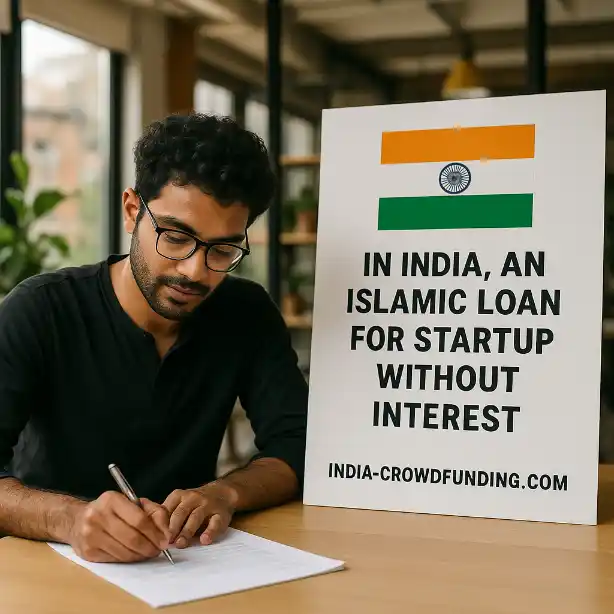
Startup funding without interest: what founders look for
Islamic startup loan in India covers the search by founders for early capital that carries no interest and does not finance a prohibited activity. The term is easier to say than to deliver. No licensed Islamic bank exists in India, so a founder has to build the funding from several imperfect pieces.
Startups sit awkwardly with ordinary loans anyway. A new venture has little trading history, uncertain revenue and few assets to pledge. Islamic finance recognises that risk. Its preferred tools for a young business are not a debt with a fixed charge but a partnership, in which the financier shares both the profit and the chance of loss.
This matters in practice. A founder who accepts a fixed-return loan from an investor and calls it Islamic has not changed the substance. What counts is whether the money provider really shares in the outcome, whether the business activity is permitted, and whether the contract has been read by someone qualified to rule on it. That ruling belongs to a scholar or a Sharia adviser.
Prohibited activities include alcohol, gambling, pork and conventional interest-based finance. A startup in any of those fields cannot be made acceptable by changing the funding contract. A founder should check the product or service first, and the financing second.
The gap in licensed Islamic lending
Banks in India work on interest under the Banking Regulation Act, 1949. The idea of an Islamic window in conventional banks was proposed by the RBI in February 2016, following an earlier committee on financial sector reforms led by Raghuram Rajan, which in 2008 asked for a look at interest-free banking. The finance ministry did not accept the window, and the RBI said in a reply made public on 13 November 2017 that it would not pursue Islamic banking.
What remains is small. Interest-free cooperatives such as Al-Khair in Patna, which spoke of its work in 2022, and Sahulat in Hyderabad, which said in 2021 that it lent Rs 5,000 to Rs 1 lakh to small traders, serve modest needs. Neither is known to back technology or product startups. A founder who needs capital to build a product will not find enough there.
Cheraman Financial Services in Kochi was described in 2013 as an RBI-permitted non-banking company following Islamic principles, planning leasing and equity-finance products. In 2017 it was said to have made losses, so ask the company directly about its current status. It is a reminder that the idea has been tried, not a place to apply.
Partnership contracts that suit a young company
Mudarabah and musharakah are the two contracts that match startup finance most closely. In mudarabah, one party provides capital and the other manages the work. Profit is shared by a ratio fixed at the start, and a financial loss falls on the capital provider unless the manager was negligent. In musharakah, every partner contributes capital and shares profit by agreement and loss in proportion to capital.
Diminishing musharakah is a variation in which the founder gradually buys out the financier’s share. For a startup that expects to grow, it offers a route to full ownership without ever paying a charge on money. The practical difficulty is valuation: someone has to decide what the company is worth each time a portion of the share is bought.
The profit ratio is the heart of the matter. In a real partnership, the financier cannot demand a fixed sum regardless of results. It receives a share of whatever profit exists. A term sheet that guarantees a minimum return or promises repayment of capital in all cases is a loan, whatever name it carries, and a scholar would ask about it.
In February 2026, the Rifah Chamber of Commerce and Industry in Telangana held an Investor and Investee Growth Summit at FTCCI in Hyderabad, promoting profit-sharing funding through musharakah and mudarabah for small and medium enterprises. No lender was named, so the summit shows interest from the community and not a ready source of money.
Startup India recognition and tax relief
Whatever the funding, a founder can look at the government’s Startup India initiative, launched in 2016. A company applies online for recognition by the Department for Promotion of Industry and Internal Trade, known as DPIIT. The portal lists benefits for recognised startups: tax exemption, faster patent processing and self-certification under some labour and environment laws. It shows more than 60,000 startups.
Recognition is not funding, and it does not make a venture compliant with Islamic principles. It does help in dealing with investors and officials, and the portal explains the process. Founders should read the conditions on the portal itself, because eligibility and benefits can change.
A tax change affecting outside investors was announced in the Budget speech of 23 July 2024, when the Finance Minister said the angel tax under Section 56(2)(viib), charged at 30.9%, would be abolished for all classes of investors. Before that, a startup issuing shares above fair value could face tax on the difference. Founders should confirm the current position with a chartered accountant, as the tax law has been rewritten since.
Stand-Up India and Mudra: conventional bank routes
Two public schemes are often named for new entrepreneurs. Stand-Up India, handled through the SIDBI portal, offers bank loans from Rs 10 lakh to Rs 1 crore for a greenfield enterprise in manufacturing, services or trading. Each bank branch is expected to lend to at least one SC or ST borrower and one woman borrower. For an enterprise that is not an individual, at least 51% of shareholding and control must lie with an SC, ST or woman entrepreneur.
In 2020 the scheme was announced as extended up to the financial year 2025. A founder should ask a bank branch whether the scheme is still taking applications after FY2025. State Bank of India applies the same Rs 10 lakh to Rs 1 crore range, an age of 18 or above, greenfield projects only, and a requirement that the applicant not be a defaulter.
The Pradhan Mantri Mudra Yojana, launched on 8 April 2015, offers loans up to Rs 10 lakh to non-corporate, non-farm small and micro enterprises under the names Shishu, Kishore and Tarun. Because it targets non-corporate units, a private limited startup may not fit. Both schemes run through banks that charge interest, so they raise the same religious question as any bank loan, which a scholar must answer.
Equity crowdfunding, donation sites and peer lending
Equity crowdfunding, in which many small investors take shares, has an uncertain position in India. In June 2014 SEBI circulated a consultation paper that would have limited it to accredited investors, startups under four years old raising at most INR 10 crore a year, and up to 200 non-QIB investors. SEBI said the paper did not necessarily mean rules would follow. In early September 2016 it warned investors about more than six equity crowdfunding platforms, calling them unauthorised, unregulated and illegal. SEBI’s position can change, so any platform offering shares to the public should be checked with SEBI first.
The well-known sites do something different. Ketto describes fundraisers for medical, education, memorial, sports and NGO causes, and Milaap for personal needs, medical emergencies and NGOs. Milaap says setting one up takes less than 10 minutes and lists platform fees of 0%. LaunchGood states 0% platform fees but does not say it serves startups in India. IndiaZakat is a zakat-based site focused on education, healthcare and livelihood. None of them offers startup funding or Islamic startup loans.
Peer-to-peer lending is a regulated route, but it is lending and not a partnership. Under the RBI directions of 28 November 2025, a borrower may take no more than INR 10 lakh across all such platforms, loans must be clean and unsecured, maturity is capped at 36 months, and platforms may not promise assured returns. A founder who sees such a platform advertised as halal should ask for the contract and a scholar’s view.
Practical checks for a founder seeking an Islamic startup loan in India
Begin with the business itself: is the activity permitted, and can its income be described plainly? Then write down what you need, for what, and for how long. This makes the conversation with a scholar, an investor or a bank concrete.
Ask any funder for the contract in writing. Look for who owns what, how profit is calculated and what happens if the company fails. If a loan is offered by a regulated lender, the Key Facts Statement, mandatory for retail and MSME loans since 1 October 2024, shows the full cost and the repayment plan, and charges outside it cannot be added without consent.
Finally, never rely on a promise of guaranteed approval or guaranteed returns. Funding depends on the business, the investor and the documents, and nobody can promise it in advance. A qualified scholar should review the structure before money is accepted.