
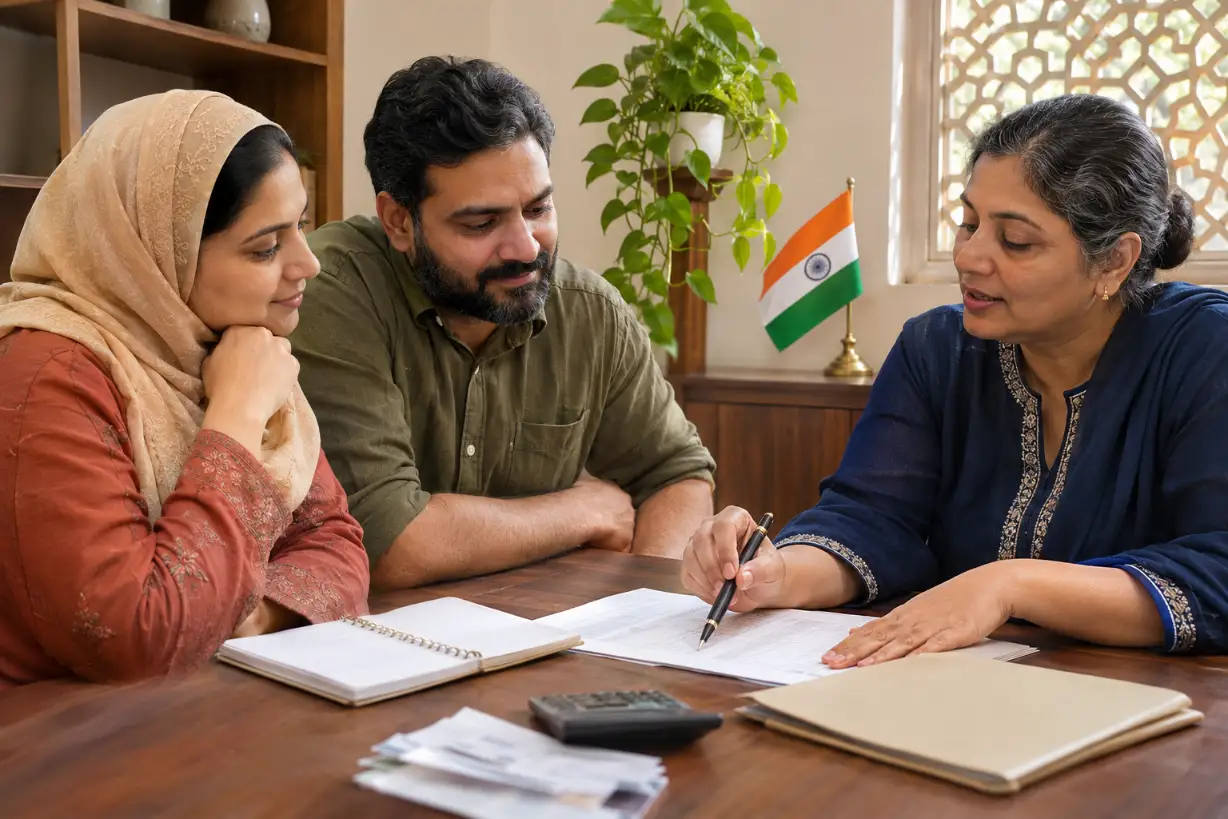
Personal borrowing without interest for Indian households
An Islamic personal loan in India is a small loan for personal or household needs that a lender gives without charging interest, and in practice it is offered by member-owned co-operative societies rather than by banks. India has no licensed Islamic bank, so a borrower cannot walk into a branch and ask for a Sharia-based personal loan the way a customer might in the Gulf or in Malaysia. What exists instead is a limited set of credit societies that lend to their own members, replace interest with a fixed service charge and fund the loans from member savings and share capital.
That shapes everything a borrower should expect. Eligibility depends on membership and on a savings record, not on a product brochure. Amounts are modest, terms are short and the society usually asks for guarantors and a security. Nobody can promise that an application will be approved, and the societies themselves decide each case after an appraisal.
The rest of the picture is about choosing carefully. A household that needs money for a wedding, a medical bill, school fees or a repair has several routes: a conventional bank loan, a government scheme, a gold loan, help from family, or a co-operative that lends without interest. Each has a different cost and a different religious position, and the last one is the focus here.
Qard hasan: the idea behind benevolent loans
Most interest-free personal lending rests on the contract of qard hasan, a benevolent loan. The borrower returns only the principal that was handed over. The lender may recover genuine administrative costs but may not earn a profit from the loan itself. The point of the contract is help, not income.
Islamic finance treats interest, known as riba, as something to avoid. A benevolent loan sidesteps it by removing any return that grows with time or with the size of the debt. This is why a society that offers such loans cannot simply rename a monthly interest charge. The charge has to be a real, fixed cost of running the service and it has to be known before the borrower agrees.
Benevolent loan versus a sale-based product
A benevolent loan is not the same as a murabaha, where the financier owns an asset and sells it to the customer at cost plus a disclosed mark-up payable later. Murabaha suits the purchase of a specific item. A personal loan for general household needs is cash, so the benevolent structure is the natural fit. If a provider calls a cash loan a sale, the borrower should ask what asset is actually being sold and who owns it at the time of sale.
Whether a particular arrangement is acceptable is a question for a qualified scholar or a Sharia adviser. The name printed on a form does not settle it. A borrower with doubts can put the loan agreement in front of a scholar before signing.
The Al-Khair demand loan in Patna: membership and balance rules
One of the clearest published examples in India is the interest-free demand loan of Al-Khair Co-Operative Credit Society. The society is registered as a multi-state co-operative with the number MSCS/CR/136/2002 and has its registered office at Haroon Nagar, Sector-2, Phulwari Sharif, Patna. It works in Bihar, Jharkhand, Uttar Pradesh and Delhi, so a borrower outside those areas should not expect to qualify.
The loan is meant for personal or household needs and is open to registered members only. Membership alone is not enough. The member’s account must be at least three months old, with regular daily deposits made into it. The balance in the account must equal ten per cent of the amount requested, and the member must also hold shares worth ten per cent of the loan.
A simple example shows how the two ten per cent conditions work together. A member who wants a loan of Rs 50,000 would need Rs 5,000 as balance and Rs 5,000 in shares, on top of the three-month deposit history. This is only an illustration, and the exact treatment of each case rests with the society’s staff. It shows why the product rewards people who already save with the society and gives little help to someone who needs money tomorrow.
The society also states that it does not offer online loans. A borrower therefore deals with a branch in person, fills in a paper application form that costs Rs 20 and completes the appraisal there. Anyone who finds a website or an app claiming to issue this society’s loans entirely online should treat the claim with suspicion and check with the society directly.
Term, purpose and the fixed service charge
The demand loan runs for eight months. That is short compared with a bank personal loan, and it suits a clear, near-term need such as a medical bill or a school fee rather than a long project. Before signing, a borrower should ask the branch for the repayment pattern, the number of instalments and any early-closure terms in writing.
Instead of interest, the society charges a one-time fixed service charge, and GST is added on top. The word fixed matters. It does not rise if the borrower pays late or keeps the money for the full eight months, which is the feature that separates it from interest. The borrower should ask the society for the exact rupee amount of the service charge and for the GST on it before agreeing.
To judge whether the arrangement is reasonable, compare the total cost with the alternative. Take the service charge plus GST, add the Rs 20 form fee, and divide by the amount borrowed. Then set that figure against what a bank or an NBFC would show in its Key Facts Statement. A lender that is open about costs will give the borrower every number needed for this comparison.
What a delay can cost
A society that follows the benevolent principle should not add a growing penalty to a late balance. Any late-payment arrangement should be explained before the loan is sanctioned, and a borrower who expects a cash-flow gap should speak to the society early. Asking is not a guarantee of relief, but it is better than staying silent.
Guarantors and security for a member loan
The society asks for people who stand behind the borrower. For a loan under Rs 1 lakh, the member needs one member guarantor and one guarantor from the family. For a loan of Rs 1 lakh or more, the requirement rises to two member guarantors and one family guarantor. A borrower should speak to these people before applying, because a guarantor takes on a real obligation if the loan is not repaid.
A security is also required. The accepted forms are a bank cheque, gold, an original property document or an original vehicle document. Handing over original papers means the borrower cannot sell or pledge that asset elsewhere while the loan is open, so the choice of security deserves thought. A cheque is the lightest option but is a serious commitment, since a bounced cheque can lead to legal trouble.
These conditions explain why such a loan can be slow to arrange. The borrower needs to gather savings history, shares, guarantors and a security, and each element involves another person or a document. Starting early and keeping copies of everything that is submitted prevents most delays.
Jan Seva and the self-help group route
A second model comes from Jan Seva, which runs microfinance aimed at marginalised people organised in self-help groups. Its transactions are described as interest-free, it takes no collateral and it relies on joint liability within the group. This is a group product, so an individual with no group cannot use it for a personal need in the same way as a member of the Patna society.
In the fee-based model, a self-help group that has saved for a year can become eligible for an interest-free loan of twice its savings. The group pays a one per cent processing fee and contributes four per cent of the loan to its own fund. For a group that saved Rs 1 lakh in the year, that would mean a loan of Rs 2 lakh, a Rs 2,000 processing fee and Rs 8,000 paid into the group’s fund, as an illustration and not a quoted case.
Joint liability means one member’s default becomes the group’s problem. Members should be comfortable with each other’s finances and should agree rules on repayment before the group applies. Details of eligibility and timelines should be confirmed with the society.
Why banks and policy leave this space small
Banks in India work on interest under the Banking Regulation Act, 1949, and the Reserve Bank of India regulates them. In February 2016 the RBI proposed an Islamic window in conventional banks, but the finance ministry did not accept the idea. In November 2017 an RTI reply said the RBI would not pursue Islamic banking, pointing to equal access to banking for all citizens.
As a result, interest-free personal lending sits with co-operatives registered under the Multi-State Co-operative Societies Act, 2002, or under state law. These societies are not RBI-licensed banks. Deposits kept with them do not carry the protection that bank deposits have, and a borrower who is also a depositor should keep that in mind.
The practical consequence is that choice is limited and reach is regional. Someone in Kerala, Gujarat or Tamil Nadu will not find a branch of the Patna society nearby. They may find another local society, but its terms must be checked on their own merits.
Checking an Islamic personal loan in India before you sign
Before accepting any interest-free personal loan, ask for the society’s registration number and look it up with the relevant Registrar of Co-operative Societies. Ask for the service charge and GST in rupees, the repayment schedule, the guarantor and security requirements and the consequences of late payment. Get all of it in writing.
Be careful with anyone who promises quick, guaranteed approval, asks for a fee before sanction or contacts you through a messaging app. Genuine societies appraise applications and take security. If an offer sounds too easy, speak to the society’s office, and report suspected fraud through the channels that exist for online financial crime.
Finally, keep expectations realistic. An interest-free loan is a modest tool for a short, defined need. It is not a substitute for a fund for large purchases, and it does not remove the duty to repay. A qualified scholar can confirm whether the terms of a specific loan agreement meet religious requirements.