
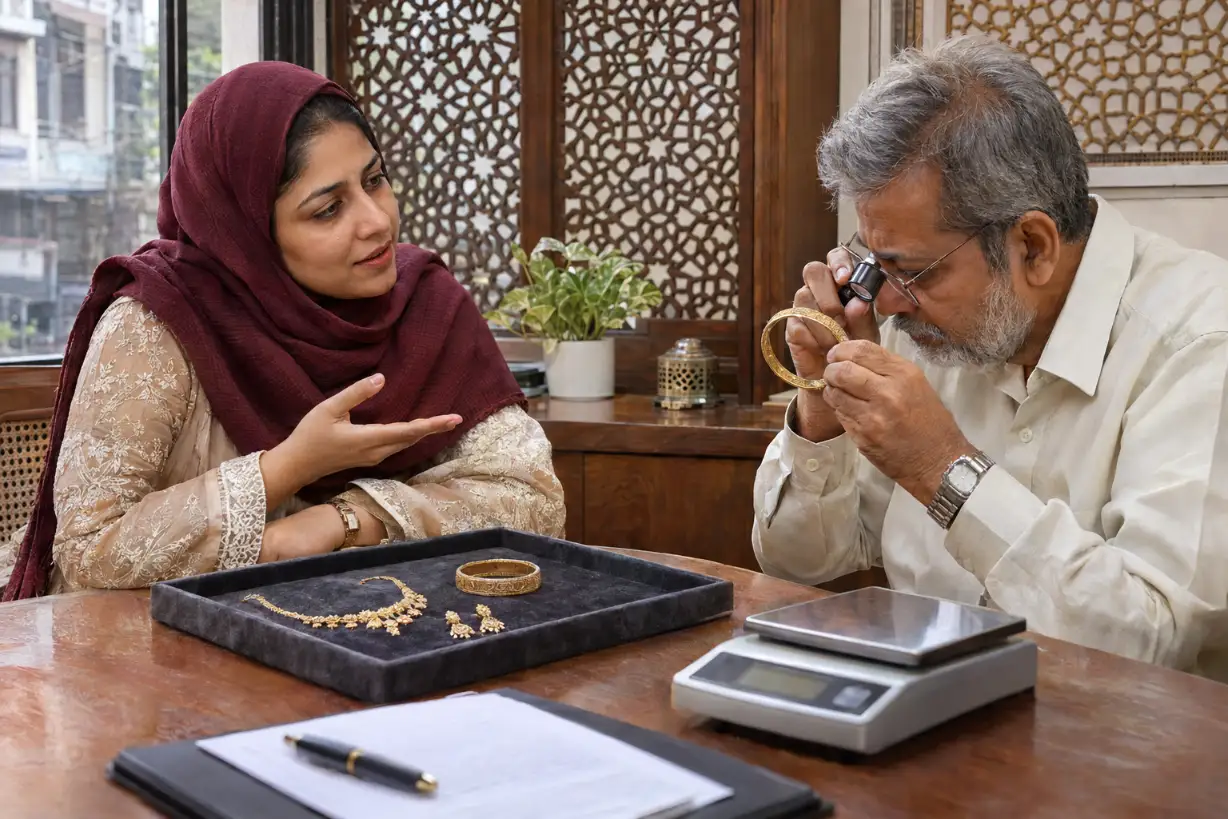
What an Islamic gold loan means when gold is the collateral
An Islamic gold loan in India is a loan against pledged gold in which the lender does not charge interest, and the gold is held as rahn, a pledge that secures the debt until it is repaid. It is meant for people who want quick cash against jewellery without entering an interest-based contract, which Islamic finance treats as riba.
The idea sounds simple, but India has no licensed Islamic bank, so the ordinary gold loan sold by banks and finance companies is priced on interest. The interest-free version exists only in a few small, member-based credit societies, and each one sets its own rules. Anyone looking for this product should expect a local society with a limited membership, not a nationwide lender with branches in every town.
The contract underneath matters more than the label. In classical terms the borrower receives a plain loan, the lender takes the gold as security, and the lender must not earn anything from the loan itself. Whether a particular arrangement really follows that pattern is a question for a qualified scholar or the society’s Sharia adviser, not something a product name can settle.
Rahn: how the pledge works in a gold financing contract
Rahn is the Islamic term for a pledge or collateral securing a debt. The pledged item stays the property of the borrower, but the lender may keep it until the debt is settled and may sell it if repayment fails. Gold suits this role well because it is easy to weigh, store and value.
Pledge and loan are two separate things
A careful structure keeps the loan and the pledge apart. The loan is the money handed over; the rahn is only the guarantee. If the lender also charged a fee tied to the amount and the time the money is outstanding, the arrangement would start to look like interest under another name. That is the point scholars examine most closely.
Custody of the gold
Because the lender holds your gold, safe custody is part of the deal. Ask where the ornaments are kept, whether they are insured, and how the society records the weight and purity at the time of pledging. A written receipt with these details protects both sides.
Whether a lender may use the pledged item or benefit from it is a question for the scholar who reviews the contract. A society that wears, lends or trades your jewellery would be a reason to stop and ask. Raise the question directly and get the answer on paper.
The interest-free gold loan offered by a Karnataka credit society
One concrete example is Eisar Credit Souharda, a co-operative that offers an interest-free gold loan secured by gold pledged as rahn. The society describes the loan as intended for members’ education, consumption and medical needs. It is a members-only product, not an open offer to the general public.
Membership comes with a share requirement. For secured loans the borrower must hold society shares worth at least 2.5 per cent of the loan amount, and the figure rises to 5 per cent for unsecured loans. In practice this means a borrower puts a small part of the amount into the society itself before the money is released, and should plan for that cash.
Repayment is described as monthly instalments within a stipulated period. The repayment period, the maximum amount, the branch town and the gold quantity accepted are details to ask the society’s own office for, in writing, before you hand over any ornaments.
The same society also lists other products, including a cost-plus asset loan, a group loan and debt financing. Those are separate contracts with their own rules and are not covered by the gold pledge described here.
What an Islamic gold loan in India may still cost
Interest-free does not mean cost-free. The society says charges are fixed on the estimated cost of operation, which is the usual way an interest-free lender recovers the real expense of running the service, such as staff, valuation, storage and paperwork. No amount or percentage is published, so a borrower cannot compare it with a bank’s rate without asking.
The principle behind such a charge is that it covers actual cost and carries no profit. A qard hasan, the benevolent loan, allows the lender to recover real administrative expenses but not to earn from the lending. A charge that grows with the loan amount and the months outstanding deserves a closer look, because that pattern resembles interest.
Before signing, ask for every charge in writing: processing, valuation, custody, renewal, late payment and release. Indian rules for banks and other regulated lenders require a Key Facts Statement for retail loans since 1 October 2024, showing the all-inclusive cost, and charges missing from it cannot be added without the borrower’s consent. A small society may not be bound by that rule in the same way, but the document is a good model for what to request.
- The exact amount or percentage of the operating charge
- Whether valuation and custody are included or billed separately
- What happens on a missed instalment, and whether any penalty goes to charity
- The cost, if any, of getting the gold back after the final payment
RBI limits that shape every gold loan in the country
The Reserve Bank of India issued Lending Against Gold and Silver Collateral Directions in June 2025, with compliance due by 1 April 2026. They apply to commercial banks, co-operative banks and non-banking finance companies. Whether a small credit society registered under state law is covered is a point to ask the society, since each type of institution answers to a different supervisor.
The directions limit how much metal one borrower can pledge: 1 kg of gold ornaments, 10 kg of silver ornaments, 50 grams of gold coins and 500 grams of silver coins. Loans against primary gold or silver, such as bullion, are not allowed. So an Islamic gold loan in India secured by ornaments fits the framework, while a bar or biscuit would not.
Loan-to-value ceilings
For consumption loans the maximum loan-to-value is 85 per cent up to Rs 2.5 lakh, 80 per cent above that and up to Rs 5 lakh, and 75 per cent above Rs 5 lakh. A consumption loan repaid in a single bullet payment can run for at most 12 months. These ceilings protect the borrower from over-borrowing against the metal, whatever the lender’s religious basis.
The directions also provide that silver jewellery, ornaments and coins can be pledged, while silver bullion and silver exchange-traded funds cannot, and that a bullet-repayment loan is renewed only after the interest is paid. An interest-free society has no interest to pay, so ask how renewal works in its own terms.
Getting the gold back, and what happens after a default
Under the RBI directions, pledged items must be released within seven working days of full repayment. If a regulated lender delays, it owes the borrower compensation of Rs 5,000 for each day. Keep the final-payment receipt and the original pledge slip, because both are needed on the day of release.
When a borrower defaults, the lender may auction the gold. The directions set the reserve price at no less than 90 per cent of the current value of the collateral, and at 85 per cent after two failed auctions. Ask any lender, regulated or not, how much notice it gives before a sale and whether any surplus is returned to you.
From an Islamic point of view, a sale of the pledge must go to settle the debt only. The lender may recover what is owed, but any amount above that belongs to the borrower. A written clause on this point is worth asking for, because a society that handles such cases fairly will not mind stating it.
A borrower who expects difficulty should speak to the society before the due date. Ask whether the society can rearrange the instalments, and get any agreement in writing.
Questions to settle before pledging your ornaments
Start with the legal identity of the lender. Ask for the registration number, the registrar’s name and the address of the office, then confirm them independently. For a credit society the state Registrar of Co-operative Societies, or the Central Registrar for a multi-state society, is the body that registers it. An organisation that cannot show these details should not hold your gold.
Next, ask for the contract in writing and have a scholar you trust read it. Check how the pledge is described, whether any fee grows with time, and what the society does with the metal in the meantime. Compliance is judged by scholars, and the society’s own claim does not replace that review.
Finally, compare with the alternatives honestly. A bank gold loan follows the RBI rules above but charges interest. A society loan avoids interest but is smaller, local and less regulated. Neither can be guaranteed to suit you, and no approval or amount can be promised in advance. Weigh the gold you are willing to part with against the need, and borrow only what you can repay on schedule.
- Registration number and registering authority of the lender
- Written description of the pledge and where the gold is stored
- List of all charges, with amounts, in writing
- Release procedure and timeline after the last instalment
- Name of the Sharia adviser or board, if one exists